The Mystery of Birth

Birth is, and has always been, a mystery. It is unpredictable, powerful, deeply human, and deeply sacred. No matter how much we learn about physiology or prepare with intention, there remains something about birth that defies explanation—something that humbles us, quiets us, and invites us to pay attention. A gentle birth plan, formed with care and openness, doesn’t diminish this mystery—it helps create the space in which we can meet it.
Mystery in the Christian tradition
In the Christian tradition, mystery doesn’t just mean something we can’t understand. As Metropolitan Kallistos Ware writes, mystery refers not only to what is hidden, but also to what is revealed—just enough to draw us in, to stir our desire to come closer, to participate, to learn. Mystery is not a puzzle to be solved, but a holy unfolding we are invited into.

Birth as Mystery
Birth, too, reveals and conceals. It brings forth a new life while shaping and transforming the birthing person. And like all true mysteries, it cannot be fully predicted or contained—it can only be honored.
In Fertile Ground, Laura Jansson writes of birth as a mystery in the theological sense: not something foreign to faith, but deeply intertwined with it. She reminds us that birth invites us into the same sacred pattern we find throughout our spiritual lives: a rhythm of preparation, surrender, and transformation.
Mystery in Tension with Preparation
And yet—many people who are preparing for birth find themselves caught in a tension.
- They want to honor the sacredness of the experience…
- but also make a plan.
- They want to feel informed and empowered…
- but not rigid or controlling.
- They long to prepare well…
- but fear that a plan might “get in the way” of surrender, or box them into choices they can’t ultimately control.
So: Is it possible to plan and still honor the mystery and unpredictability of birth?
Yes. But the planning must be open-hearted and allow for flexibility and attunement.
A gentle birth plan is not a rigid script. It’s a way of preparing that is open-hearted and flexible—rooted in what matters most. When done well, it doesn’t close us off to mystery. It helps us make space for it.
What is a “Gentle Birth Plan?”

A gentle birth plan is intentional, open-hearted, and adaptable. It begins with the understanding that we cannot control every twist and turn of labor—but we can prepare in a way that grounds us in what matters most.
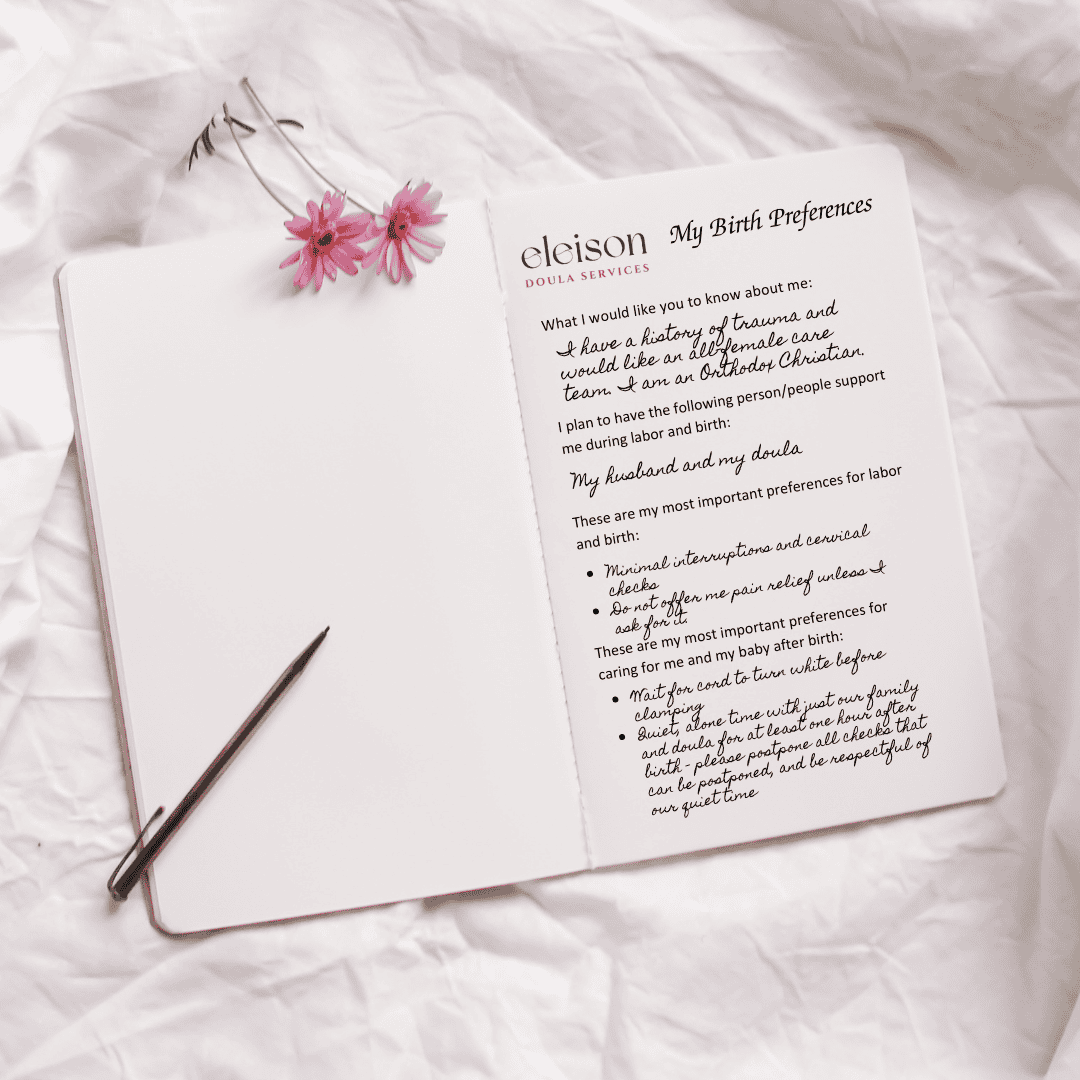
Unlike a detailed script trying to account for every possibility, a gentle birth plan is more like a touchstone. It helps you clarify what brings you comfort, confidence, and a sense of safety. It gives you space to consider your hopes and needs—not to guarantee an outcome, but to help you feel steady and supported, whatever may come. When I talk to my clients about birth planning, we will often use the phrase “birth preferences” instead of “birth plan.” This conveys your values and priorities, without locking you in to plans that may need to adapt to changing circumstances.
How to Write a Gentle Birth Plan
Rather than focusing on strict outcomes or rigid preferences, gentle birth planning invites you to reflect on things like:
- Are there any cultural or spiritual traditions that are important for you to bring into your birth space?
- What kind of atmosphere will help you feel calm?
- What coping techniques or rituals resonate with you?
- Who do you want with you—and what kind of presence do you need from them?
- Are there certain newborn care decisions you’ve already thought through?
- How do you prefer to approach decision-making if unexpected choices arise?
- Do you want to create a sense of sacred space that includes prayer, icons, or other meaningful elements?
These are all gentle, human things—not demands, but desires. And naming them can be powerful.
A gentle birth plan is less about control and more about care.
It’s a way of tending to the space around your birth—not just physically, but emotionally and spiritually.
It doesn’t have to be long or complex. In fact, the most helpful birth plans are often just a short list of thoughtfully chosen points—shared with your birth team to help them understand what’s most important to you. Sometimes, the process of making the plan is even more powerful than the plan itself. It can help you and your partner (or support person) get on the same page, spark conversations with your care provider, and invite your doula and loved ones to walk with you in a more intentional way.
Honoring Sacred Space—Internally and Externally
Sacred space is not only something we create around us—it’s something we carry within us. In pregnancy, your body becomes a living sanctuary. Your baby already dwells in sacred space: the quiet, hidden sanctuary of your womb. This space is warm, protected, rhythmic with breath and heartbeat. It is not sterile or clinical—it is full of life, presence, and love. The womb and the baby it contains were created mysteriously. We participated in this creation, certainly, but it is a miracle that no amount of deliberate human activity could ever bring about on its own.
As your baby prepares to cross from that hidden sanctuary into the world, it’s natural to want their first moments in this new environment to be just as sacred. Birth is not only a physical event; it’s a spiritual one. A gentle birth plan can help you consider how to mark this crossing with intention and reverence.
Whether you’re birthing at home, in a hospital, or at a birth center, there are ways to tend to both the external and internal sacred space of your birth:
🌿 Ways to Create External Sacred Space:
These are some ideas stemming from my own Eastern Orthodox Christian tradition. You can use them as inspiration or adapt them to your own traditions.

- Icons: Place a small icon of the Theotokos or a patron saint of your family nearby, either on a table or wall within your sightline.
- LED candles or soft lighting: Gentle, flickering light can invite calm and signal to your body that it is safe to release.
- Music or chant: Play recordings of spiritual music or chant that help you stay connected and prayerful.
- Prayer with breath: Breathe with the Jesus Prayer or another short prayer that can become your rhythm during contractions. (The Jesus Prayer—“Lord Jesus Christ, Son of God, have mercy on me”—is a short, ancient prayer used in the Orthodox tradition to cultivate stillness and attentiveness to God.) One beautiful and effective way to do this is to have your partner or doula say the prayer for you while you concentrate on breathing deeply through each contraction to the sound of the repeated prayer.
- Holy water or blessed oil: Anoint your belly or forehead as you enter labor, or ask your support team to do so, blessing you and your baby.
For those planning a home birth, your sacred space might already be woven into your surroundings—your icon corner, your kitchen where you’ve prepared nourishing food, the candle from your wedding, photographs of loved ones. Home becomes what the Church has always taught it is: a “little church,” filled with quiet holiness.
Wherever you give birth, these simple elements—gentle lighting, intentional prayer, meaningful symbols—can become the architecture of sacred space.
🌬️ Creating Internal Sacred Space:
Beyond the room itself, sacred space is also an inner posture. A heart turned toward God. A spirit held in peace, even amidst intensity. That’s not something you can manufacture—but it can be supported by your surroundings, your intentions, and your community.
When we take time to prepare that space—both around us and within us—we are better able to stay grounded in the mystery of birth. The unknown becomes less overwhelming when we feel held in something holy.
Sacred space helps you feel rooted in the presence of God, even as birth unfolds in unpredictable ways.
As your doula, one of my deepest joys is helping you protect and tend that sacred space. I can hold the quiet, shield you from distractions, keep the lights low, offer a prayer or a psalm, and help others in the room honor your intentions. Whether I’m refilling your water or gently praying with you through a contraction, I’m there to help you stay connected to what’s most important—so you don’t have to hold it all alone.
Making Room for the Unfolding
Birth rarely goes exactly as imagined—but that is part of its mystery. Even with all the preparation in the world, birth has its own rhythm, its own wisdom. It unfolds in ways that are sometimes surprising, sometimes challenging, often beautiful—and always transformative.
A gentle birth plan doesn’t try to script every detail. Instead, it helps set the tone for how you respond when birth begins to take its own shape. It’s a way of preparing your heart and mind—not just your to-do list—so that when things shift, you can move with grace instead of fear.
Surrender and flexibility are not failures of planning. They are part of the process. They are signs that you are listening to your body, your baby, and the unfolding moment.
How a Gentle Plan Adapts to the Situation
Gentle planning prepares you to pivot—not to panic—when the unexpected happens.
I’ve walked alongside families whose births unfolded very differently than they had hoped:
- A home birth that transferred to the hospital but still honored sacred space with prayer, music, and warmth.
- A planned unmedicated labor that shifted to an epidural, where the mother said afterward, “I felt like I could finally rest—and I was still so present when he was born.”
- A home birth that went much faster and more intensely than expected, so that the baby was born before the midwife had even arrived. Although the baby was born in the midst of loud confusion, she was immediately embraced with love and prayers, and anointed by her parents.
- A cesarean birth where the parents took time to pray beforehand, and then played worship music afterward as the mother fed the baby from her breast for the first time.

Each of these births looked different from the original plan. And yet, each was filled with dignity, care, and deep beauty. The planning they had done ahead of time didn’t go out the window – instead, it helped guide them through their responses to the unfolding changes, making sure that their values and priorities were still honored.
Gentle birth planning gives you the inner flexibility to say: This isn’t what I pictured—but I am still here. I am still connected. I am still giving birth in a sacred way.
When we make room for the unfolding, we are not letting go of what matters—we are discovering new ways to hold it.
How I Support Clients Through Both Planning and Surrender
When I work with clients, we begin not with a checklist—but with a conversation. We talk about what you hope for, what you fear, and what matters most to you. We explore not only birth preferences, but the deeper values underneath them: What makes you feel safe? What brings you comfort? How do you want to shape your baby’s first moments in this world?
Together, we create an attuned, gentle birth plan—one that honors both your intentions and the unpredictable nature of birth. We name your desires, and we also talk openly about the unknown. Then, we speak honestly about the possibility of change and how you’d like to be supported if that happens. This process makes space for both clarity and flexibility, for both agency and surrender. When needed, I provide education about options and aspects of birth that can help you to clarify your intentions.
The role of a doula
Throughout your birth, my presence is calm, compassionate, and nonjudgmental. I don’t measure your experience against a standard of “how birth should be.” I measure it by something far more sacred: Are you being treated with dignity? Do you feel seen, respected, and supported? Is the love and care surrounding your baby’s arrival aligned with your deepest hopes?
My role—and the role of gentle birth planning—is not to help you control birth.
It’s to help you feel supported, held, and witnessed, no matter how birth unfolds.
More than anything, I want to help you welcome your baby into the world in a way that reflects the tone you want to set for their life: a tone of safety, love, reverence, and care. That begins not with perfection, but with presence.
And what if it’s not the birth itself, but the people involved, that are threatening your peace? What if someone in the room is introducing fear, judgment, or pressure?
Then that, too, is something we talk about.
Because surrender is only possible in an environment of safety. And part of my role is to help protect that environment.
- To help you advocate for what you need.
- To support your boundaries with quiet strength.
- To help create a birth space—internally and externally—that reflects what is most sacred to you.
Closing: The Mystery Is the Gift
Together, we can embrace birth not as something to master, but something to receive. Birth is a giving and a receiving — of life, of love, and of grace. It is an offering to God, and in turn, a moment of communion with Him.
Planning gently does not mean resisting preparation; it means preparing with open hands. Just as a farmer plants with prayer, tending the soil with care while trusting God for the harvest, so too can you plan for birth with devotion and surrender.
When birth invites you into the unknown, may you step forward with gentle plans, a steady heart, and the deep, sacred peace of knowing you are not alone.
If this sounds like something that you want to experience more deeply, fill out the Contact Form, and I will reach out to chat.
Leave a Reply